Breaking the Stigma

July 7, 2026
Veterinary professionals dedicate their lives to caring for others. They comfort families through difficult decisions, support one another through demanding days, and often carry an emotional weight that extends far beyond the walls of the hospital.
But caregiving can come at a cost. The challenges veterinary professionals face, whether personal loss, compassion fatigue, burnout, grief, or mental health struggles, are often carried quietly. Breaking the stigma surrounding mental health starts with creating space for honest conversations and reminding one another that no one has to navigate difficult moments alone.
For hospital manager Allyson Mihalko, this message is deeply personal.
In 2023, Allyson lost her daughter, Shyla, to suicide.
Shyla spent her young adult life working with troubled teens before becoming a probation officer in Denver, where she made a meaningful impact on people experiencing some of the most difficult moments in their lives. Driven by a desire to make the world better for her own daughter, she dedicated herself to helping others while also living with Borderline Personality Disorder.

“I want Shyla to be remembered as the person she was, not just being remembered for how she died. She was so much more than the worst day of her life,” Allyson shared. “She was a daughter, an amazing mother, someone who lived her life trying to help people. She had to fight demons in her head every day and I want people to know how incredibly courageous she was in accomplishing the things she did while, at the same time, fighting one of the most difficult mental illnesses there are.”
Finding the Right Support
In the aftermath of losing Shyla, Allyson found herself navigating overwhelming grief while the rest of the world seemed to continue moving forward.
"The grief was overwhelming, and I was trying to just get through basic functions while carrying a level of pain that is still indescribable," she recalled.
Like many people experiencing profound loss, Allyson knew she needed support but struggled with the energy required to find it. The process of searching for a therapist felt daunting, and finding someone who truly understood her experience proved difficult.
Eventually, she found support through Lyra, a mental health benefit offered through Vetcor, which connected her with a counselor who became an essential part of her healing journey.
"The fact that it was easy access made a huge difference," Allyson said. "I didn’t have the energy to continue looking for a counselor on my own, and Lyra helped remove those boundaries."
"My therapist has given me a safe place to say the things that are the hardest to say out loud. She has helped me to understand that this is something I won’t ever 'get over.’ It’s something I have to learn to carry,” she said.
Through therapy, Allyson gained grounding techniques, tools for managing PTSD, and a trusted partner to help her process the complex emotions that accompany suicide loss. Most importantly, she learned that healing doesn't mean letting go.
"I miss her every single day, but my therapist has helped me learn that it is possible to carry both grief and love at the same time. Talking about Shyla, sharing her story, and honoring her memory are some of the ways I continue to carry her forward."
One Size Doesn't Fit All
Veterinary professionals know better than most that every patient requires individualized care. The same is true when it comes to mental health.
The right support may look different for every person. For some, it may be therapy. For others, it may be grief counseling, a support group, peer support, employee assistance programs, mindfulness practices, faith communities, or other mental health resources. What matters most is finding the support that works for you.
Too often, people avoid seeking help because they aren't sure where to start, worry about being judged, or assume their struggles aren't "serious enough." But reaching out isn't reserved for moments of crisis. Seeking support is a proactive step toward caring for yourself, just as you encourage clients to care for the well-being of the animals they love.
A Message to Veterinary Professionals
If you're carrying the weight of personal loss, struggling with your mental health, experiencing burnout, or simply feeling overwhelmed, Allyson hopes her story serves as a reminder that support is available.
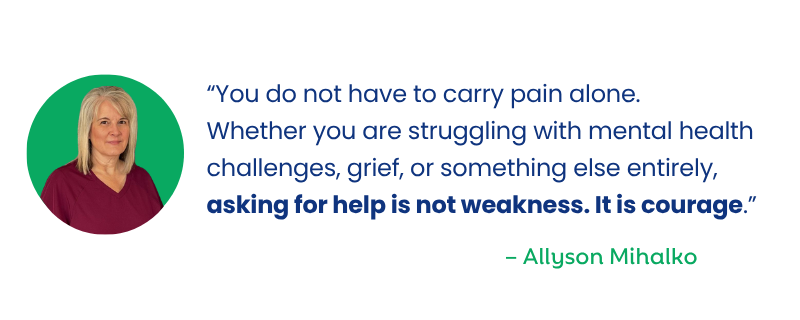
"You do not have to carry pain alone," Allyson said. "Whether you are struggling with mental health challenges, grief, or something else entirely, asking for help is not weakness. It is courage. Give yourself permission to take the first step. You don’t have to have the right words, and you don’t have to be in crisis to seek support."
By sharing her journey, Allyson hopes to encourage others to take that first step, whatever that may look like for them.
"While therapy cannot take away that pain, it gave me support, guidance, and a tiny glimmer of hope during the most difficult time of my life," she said. "If sharing my story encourages just one person to seek help, or helps another grieving person feel less alone, then sharing is worth it—and I can’t think of a better way to honor my daughter than helping someone in need as she always did when she was alive."
The veterinary profession is built on compassion. That compassion should extend to ourselves and our colleagues, too. Reaching out for help is not a sign of weakness, it's a sign of strength. And finding the support that fits your needs can make all the difference.
If You Need Immediate Support
If you or someone you know is struggling or in crisis, help is available. Call or text 988 or visit 988lifeline.org to connect with the Suicide & Crisis Lifeline. You can also reach the Crisis Text Line by texting HOME to 741741, call 911, or go to the nearest emergency room.
A Special Thank You
We are grateful to Allyson Mihalko for sharing her story and honoring the memory of her daughter, Shyla. Her openness and courage help break the stigma surrounding mental health and grief while reminding others that they are not alone.
.png)